

Retirement Guardrails: A Mindful Approach to Retirement Spending

Like many individuals nearing retirement or walking through the early years of retirement, you may ask yourself from time to time: “have I saved enough to support myself during retirement?” Perhaps you have “run the numbers,” but you wonder: “what should I do if something unexpected happens in my retirement?” You are not alone. Most pre-retirees and retirees are asking the same questions and are seeking a framework to assess whether they are tracking toward their retirement goals. Unfortunately, misinformation abounds with respect to proper spending guardrails. Many investors work with advisors who simply manage the investments without giving much thought to the impact upon financial goals. Others operate based upon a “rule of thumb” like the “4% rule,” which may not serve everyone well.
A practical solution to retirement spending conundrums is the implementation of “Retirement Guardrails.” To implement appropriate “Retirement Guardrails,” it is important to understand what the guardrails are, why they are important, and how guardrails work in practice. Most retirement investors will benefit from working with a capable advisor to define financial goals, assessing how best to navigate “retirement guardrails” effectively.
1. What are “Retirement Guardrails”?
Advisors who help their clients set “Retirement Guardrails” use a methodology with pre-set “boundaries” to evaluate portfolio withdrawals. All your sources of income in retirement (e.g., Social Security, pensions, royalty interests) are considered, alongside estimated investment portfolio outcomes. At the heart of the “guardrails” framework is a Monte Carlo simulation or an assessment of safe spending assumptions. The Monte Carlo simulation assesses 1,000 or more investment market scenarios, with varying assumptions around rates of return and investment market volatility to determine your likelihood of funding your financial goals without running out of money. In practice, the Monte Carlo simulation is often utilized to determine when a spending adjustment is required.
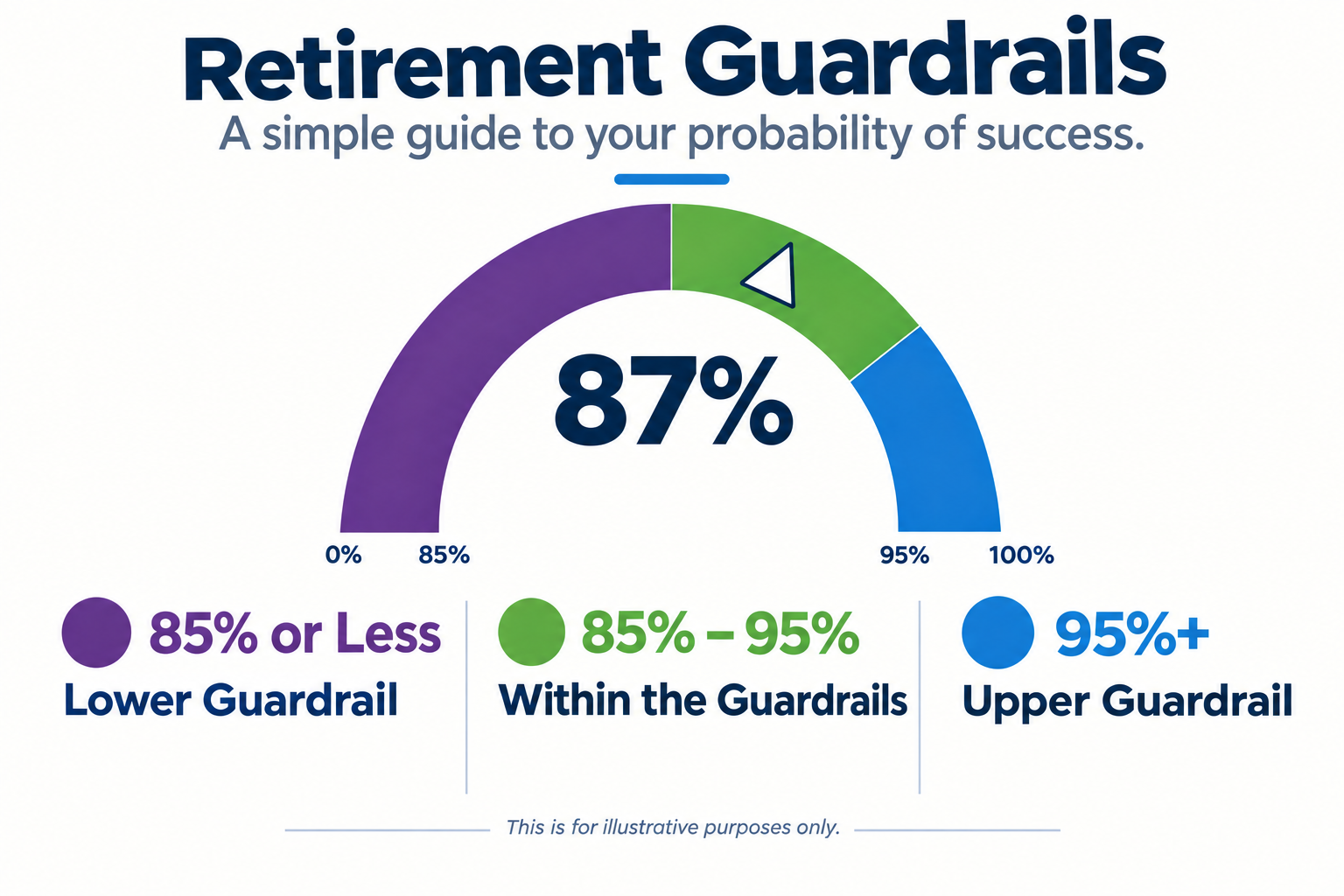
The Monte Carlo simulation indicates a probability of successful goal achievement, which is best described as a “grade” of how likely it is you are on the right track with respect to your retirement planning. There are generally three “guardrail” / “grade” rungs with the Monte Carlo analysis. For a recent retiree or near-retiree, the rungs are as follows: upper (95%+), lower (<85%), and acceptable (85%-95%). Scenarios above the upper guardrail indicate you could prospectively “dream bigger” (spend or give more) or accept a less volatile investment strategy. The lower guardrail indicates you may need to modify your financial goals for a period of time until investment market conditions improve, or you may need to work for longer. Lastly, the acceptable “middle ground” indicates your existing financial goals are achievable according to the Monte Carlo simulation. Modest increases or decreases in your spending are often feasible while operating within the acceptable guardrail rungs. Throughout retirement, you may experience some fluctuation between the guardrail “rungs.”
2. Why Your Retirement Spending Requires Flexibility.
For most retirees, the idea of transitioning from accumulating assets to relying on portfolio withdrawals to fund financial goals often feels unsettling. You saved your whole life and now you begin to rely upon your “nest egg.” The “Retirement Guardrails” framework helps alleviate much of the “guesswork” with respect to the amount you can comfortably distribute from your retirement accounts while remaining within the guardrails to help you accomplish your plan.
To remain within the “guardrails,” first, review your consistent retirement income sources to support your financial goals. Part-time income, Social Security income, rental income, and business profit distributions are a few income sources which can offset your portfolio withdrawals. Once you factor in your other income sources, establishing a “paycheck” from your retirement accounts (a monthly or quarterly distribution) is often a great next step for you. The “paycheck” fills the gap between your desired spending level and other income sources. After a few months with your portfolio “paycheck,” you will find you are saving in your operating account, seeing your checking account balance remain the same, or watching the balance in your bank account decline. You may need to revisit your “guardrails” if you are saving after every month, as you may experience more flexibility in your financial plan than you think. Conversely, if your bank account balance is lower after every month (even with portfolio distributions), you may wish to consider reviewing your financial goals to verify if the higher spending (which the declining checking balance would imply) fits within your financial plan.
Another important aspect of living within retirement spending guardrails is knowing how to navigate “choppy” financial markets in your retirement. Importantly, a decline in the market for a period of time does not necessarily translate to a need to drastically reduce your spending. Instead, consider the “Retirement Guardrails” framework. Revisit how the lower portfolio value affects your likelihood of achieving all your financial goals without exhausting your resources. You may find you are still within the guardrails, and you can proceed with the same “paycheck” from your retirement accounts without modifying your spending goals. Alternatively, you may find you are pushing below the lower guardrail (85% or less) and need to modify your “paycheck” amount for a time to allow your portfolio value to recover (before reverting to the same monthly disbursement once markets calm). Common areas in which we see our clients temporarily make adjustments include travel, home improvements, and car replacement timelines.
The “ups and downs” of the investment markets are part of being a long-term investor. While the volatility can feel unsettling, it is the price we must pay to generate a reasonable rate of return to facilitate achievement of goals. If you can grow comfortable with lower and upper bounds of spending, you will mitigate your risk of improperly reacting to challenging markets as they arise.
3. How Guardrails Work in Practice.
An example of how “Retirement Guardrails” work in practice may prove edifying to consider. Suppose you are married. You and your spouse are both 62 years old, with two boys and four grandkids. You and your spouse are seeking to retire in the next three months at age 63 (your birthdays are two days apart) from your respective workplaces. (Note – All the numbers below are in today’s dollars.)
Facts:
You work as an engineer, and your spouse is an attorney.
Your household income is $21,000 per month (before tax).
As you prepare for the future, you anticipate spending $10,000 (after tax) each month to fund your financial goals.
You both have almost identical Social Security benefits at full-retirement age (age 67) at ~$4,500 a month (after tax). You already concluded you shall not draw benefits any earlier than 67, but do not plan to delay receiving benefits beyond 67.
Your spouse is entitled to a pension plan when they turn 63. Benefits will amount to $1,000 (after tax) each month for the rest of your spouse’s life.
You receive oil royalties of $500 a month from a piece of land inherited from a family member. Given the historical royalties received, you anticipate the monthly amount modestly increases each year to match inflation.
You both plan to work part-time jobs from age 63 until Social Security benefits commence, and you anticipate your total income to total $4,200 per month (after tax).
Your 401(k) balance is $1,000,000 and your spouse’s 401(k) balance is $1,150,000. All of your retirement assets are pre-tax.
Your joint bank account balance is presently $120,000, which equates to one year’s worth of your retirement spending in an emergency fund.
You own a home and are debt free.
In the above example, you will face a funding gap in your financial goals (between ages 63 and 67) of $4,300 a month ($10,000-$1,000-$500-$4,200=$4,300). You will need to distribute $4,300 (after tax) from your 401(k) accounts to meet the funding shortfall. The “Retirement Guardrails” created through the financial planning process indicate you are solidly at 90% likelihood of achieving your goals. You are right in between the upper and lower guardrails.
When you attain age 67, you will no longer need to distribute funds from your retirement accounts. Your monthly income will amount to $10,500 ($4,500+$4,500+$1,000+$500) in today’s dollars, but your monthly expenses will remain at $10,000 per month in today’s dollars. You no longer need to distribute funds from your retirement accounts. Your plan guardrails now indicate a 98% likelihood of successful goal achievement. Therefore, you are able to either spend more of your resources, give funds away to charities about which you are passionate (or give to family members), or maintain the “status quo” with no further account disbursements.
Building upon the aforementioned scenario, say you attain age 75 and experience two years of negative portfolio returns averaging out to -10% per year. Your combined retirement account balances sit at $3,000,000. Also, your monthly expenses are now $20,000 a month due to higher than anticipated medical costs for you and your spouse. Thankfully, the medical conditions do not impede you from traveling with your kids and grandkids, which is important to you. Your portfolio distributions to supplement other income are now $9,500 per month due to the higher medical expenses you are experiencing. With the increased distributions and lower portfolio returns, you are now below the lower guardrail at 84% likelihood of not exhausting your financial resources before the end of your financial plan. You and your spouse pause and reflect on the lower guardrail since the less than favorable market returns and monthly spending may persist. Therefore, you decide you would like to modify your monthly spending to increase your likelihood of success to 90%. You modify your spending by temporarily lowering your dining budget by $500 a month to decrease monthly spending to $19,500 a month. Your plan is now back between the upper and lower guardrail. Once markets recover, you can readjust.
Concluding Remarks
“Retirement Guardrails” remove the emotion from the retirement spending conversation. By adding objective likelihood of success metrics, you are able to better navigate life’s financial transitions. Notably, even if you follow the guardrails framework, you will not eliminate uncertainty altogether; the approach simply affords a disciplined process so you can know when to “stay the course” and when to adapt.
To carefully review your financial situation and implement the guardrails approach, consider connecting with a CERTIFIED FINANCIAL PLANNER® / trusted fee-only financial planner. You may find that following the guardrails strategy feels overwhelming by yourself. Accordingly, you may wish to delegate the analysis to a professional, allowing you to spend more time on what matters most to you, such as spending time with your family, volunteering with charitable organizations, or traveling.
Co-Authors:
Jonathan McAlister, CFP®, CKA®
Justin Reede, CFP®, CKA®
Disclosure: The investment returns of investment securities are subject to various risks and are not guaranteed. Consult with an investment advisor representative for formal investment advice. For tax compliance advice, we recommend you consult with a CPA or Enrolled Agent. For legal advice, we recommend you consult with legal counsel. This blog post should not be considered investment or tax advice.