My Spouse Just Passed Away and They Managed the Money. What Should I Do?

Losing a spouse is one of the most challenging times in a person’s life. In addition to the emotional strain, navigating financial life after a spouse’s passing, especially if they managed the money, feels quite overwhelming. If you are currently facing the loss of a spouse who managed financial decisions for the household, there are practical ways to address the challenges you will inevitably face. One of the most important first steps, financially speaking, is to notify your estate planning attorney and financial advisor of your late spouse’s passing, if you are currently working with professionals.
In many cases, surviving spouses find it simpler to work with the attorney who handled their spouse’s estate planning. The estate planning attorney is an effective advocate who should help you communicate with the courts (assuming probate is involved) and the financial institutions with which your spouse worked. If there was not an estate plan in place for your late spouse, you should consider hiring an estate planning attorney to walk alongside of you through your state’s specific intestate laws (laws defining what occurs for the estate of an individual who died without a will). Ideally, you will wish to find an attorney who is board certified in estate planning to ensure competency. Most states offer a board certification in estate planning, but a few states do not. A great way to verify if an estate planning attorney is certified is to go to your state’s bar association and input their name. Within the attorney’s profile for the state in which they practice, you will find whether they are certified. Whichever direction you choose, partnering with an experienced estate planning attorney is essential to ensure every legal step you take is accurate, timely, and supports your long-term well-being.
Furthermore, if you and your spouse worked with a financial advisor, you will want to make the advisor aware of your late spouse’s passing. Typically, one spouse communicates more regularly with the financial advisor, leaving the other somewhat less engaged in the routine conversations. If you are the spouse communicating less frequently with the advisor, you may wish to ask your current financial advisor the following questions to equip you in the decision-making process. Even if you currently do not work with a financial advisor, consider engaging an advisor and apply similar questions during your initial conversations:
1. Could you share how you will seek to understand my goals for my financial resources moving forward?
a. The answer to the question exposes how well your financial advisor knows you or whether they will seek to grow acquainted with your values.
b. If the advisor seeks to speak about products and solutions in the first conversation rather than your values and goals, it is likely time to seek out an alternative.
2. How will you help me communicate with all pertinent financial institutions regarding my late spouse’s passing? And how do you partner with my estate planning attorney?
a. Be mindful of their initial response when you first notify them of your spouse’s passing. A great financial advisor proactively answers all of your questions after the death of a spouse, sharing a checklist with respect to next steps, and proactively coordinating with your tax accountant and estate planning attorney on your behalf.
3. Are any changes advised with regard to my investment strategy now that my spouse passed away? Should the strategy change in the context of my financial goals?
a. If a financial advisor states your late spouse invested more aggressively than you and recommends an identical investment approach, pause and evaluate the guidance carefully. Consider whether the advisor invests time in understanding your preferences, risk tolerance, and long‑term objectives or whether the advisor influences you toward an approach which creates discomfort. If an advisor provides a clear explanation as to why a more aggressive strategy supports your goals, the conversation takes a more constructive direction. In many situations, an advisor simply replicates your late spouse’s investment strategy because the option requires less effort and reduces the need to understand your personal financial priorities.
b. Furthermore, it is important to maintain an emergency fund with six to twelve months of living expenses. A prudent advisor considers your emergency fund needs and thoughtfully adjusts your portfolio.
4. How do you typically communicate with clients? How frequently will we meet?
a. An advisor’s answer shows how willing they are to adapt to your preferences instead of placing you into a “cookie cutter” service model.
b. Notably, more meetings with an advisor should occur within the first year after the loss of a spouse due to the administrative work to close, move, or transfer financial accounts.
c. A thoughtful advisor will guide you through each step of the estate resolution process.
5. Should I be concerned that I may run out of money?
a. “Will I run out of money?” is one of the most common questions individuals ask their financial advisor, implicitly or explicitly. The response of a competent and caring advisor is to avoid a thoughtless response such as: “you are going to be fine.” Instead, they should respond by analyzing your financial goals more deeply. After the advisor pursues analysis and accurately communicates understanding of your financial situation, you can feel confident in their advice.
b. Be sure to find an advisor who explains matters in a fashion you understand readily.
6. Since my late spouse primarily interacted with you, I do not understand how you get paid. Can you explain your fee structure to me? Do I pay a commission? Is your fee a flat fee? Do I pay based on the assets you manage?
a. Generally, if an advisor is operating under the commission-only model, it is difficult for them to act in your best interests because they are paid only when they sell you a product.
b. The flat‑fee model or assets‑under‑management fee structures tend to eliminate more conflicts of interest because such arrangements place the advisor on your side of the table, as compensation does not depend on generating activity within your accounts, selling you a life insurance policy, or selling you an annuity. Instead, the advisor is paid for a service. When an advisor receives (or has the ability to receive) compensation on activity, ample conflicts of interest arise.
7. When you advise me, are you legally obligated to put my interests ahead of your own (fiduciary standard), or do you operate under the suitability standard?
a. An advisor under the fiduciary standard is one who is legally obligated to do what is in your best interests regardless of compensation. Alternatively, an advisor under the suitability standard is not obligated to act in your best interest; they are able to point you toward one option which may fit for you (even if it is not what is best for you). Careful consideration is prudent when choosing between the two types of advisors.
b. Furthermore, finding a financial advisor who holds a CERTIFIED FINANCIAL PLANNER® certification or who is a Chartered Financial Analyst is something to strongly consider. The designations carry rigorous requirements before certification and hold professionals to an even higher standard of ethics.
There are several important considerations when deciding which financial advisor or financial advisory firm will serve you best. An advisor should do what is in your best interest, understand your financial goals, and most importantly, do what they say they will do. If you do not feel like your advisor is serving you in the fashion described here, consider finding a trusted advisor. You can find a CFP® Professional or consider talking to our team of experienced advisors. Be sure your advisor has experience walking alongside of clients like you experiencing the loss of a spouse.
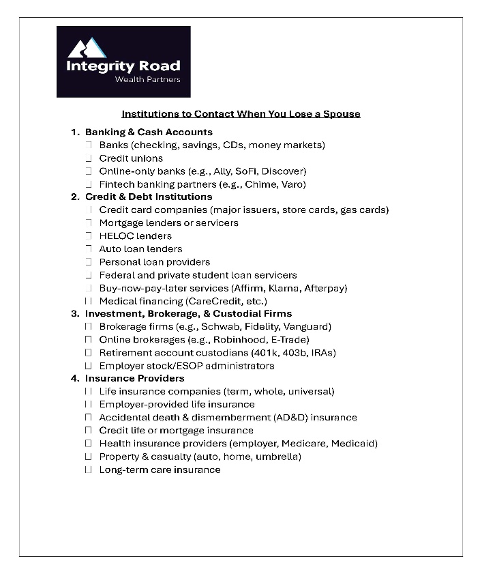
As you work with your attorney and financial advisor, you need to notify all the institutions regarding your late spouse’s passing. After contacting them, each institution will share their process for closing their account / file and transferring the account into your name or to the pertinent beneficiary. Moreover, disbursing funds to the appropriate entity may be necessary, too. Please note, most institutions require a death certificate. Typically, it takes 2-4 weeks for you to receive the official death certificate for your spouse, and a best practice is to request 10-15 copies of the certificate. You will find some institutions require an original death certificate. When you possess multiple certificates, you will save yourself the headache of needing to request more from the state. To ensure you contact all the applicable institutions, click the image below for a comprehensive checklist of the institutions to contact after the loss of a spouse. Ideally, your financial advisor should assist you with the process.
Taking purposeful steps now strengthens your financial position and creates stability during a difficult season after the loss of a spouse. If you are already working with professionals, engage your estate planning attorney, speak openly with your financial advisor, and ask the clarifying questions with regard to how each professional will support your goals moving forward. If you are not working with an estate planning attorney and / or a financial advisor, strongly consider taking the first step of contacting a professional to walk alongside you in your journey. Each proactive action you take creates momentum, builds confidence, and moves you toward a more confident financial future.
Co-Authors:
Jonathan McAlister, CFP®, CKA®
Justin Reede, CFP®, CKA®
Disclosure: The investment returns of investment securities are subject to various risks and are not guaranteed. Consult with an investment advisor representative for formal investment advice. For tax compliance advice, we recommend you consult with a CPA or Enrolled Agent. For legal advice, we recommend you consult with legal counsel. This blog post should not be considered investment or tax advice.