

Can I Afford to Give to Charity?

“It is more blessed to give than to receive.” Intuitively, most people agree with this statement. At some point in someone’s life, an individual blessed them financially, and they desire to pursue the same financial posture. Notably, in 2026, a survey found 84% of Americans set a financial resolution for New Year’s. The study also showed people desire to move forward with purpose in their financial life (i.e., charitable giving, legacy planning), but they do not know where to begin. Often, prospective givers lack the financial margin to give in the fashion they wish, even if there are material income and assets available.
The first step in determining whether you can afford to give is to clarify where your money goes every month. Interestingly, nearly 86% of individuals say they use a budget regularly, but fewer than 25% stick to their budget. Moreover, another survey found 55% of American’s lose track of their recurring payments. If you can relate to losing track of your recurring payments or falling short of observing a budget, taking the time to review your expenses is a fruitful exercise. Setting up a budgeting app like Quicken to track expenses is edifying. Another option is to see if your bank account balance (to which your monthly deposits from work or retirement accounts occur) is rising or falling from month to month. Alternatively, you can follow the step-by-step guide below regarding key budgetary areas to review to determine if you possess the financial margin to give:
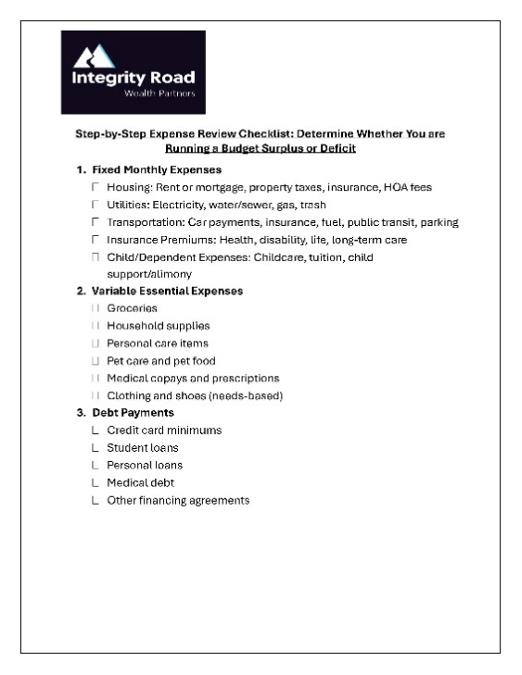
Once you review your finances, identify whether your budget results in a surplus or deficit. If you walk through the exercise of reviewing your expenses and find your budget results in a deficit, further care is necessary to reach a place at which you can give to charity. For example, consider the “Debt Snowball” or “Debt Avalanche” to eliminate debt service. In contrast, if you show a surplus in your budget, determining how much and where you may give is the next step. The following questions are designed to guide your decision-making:
Questions About Your Motivations & Values:
1. About which causes am I most passionate?
2. Do I want my giving to be local, national, global, or a mix?
3. Do I prefer supporting immediate relief or long‑term, systemic change?
4. Do I wish to support a few charities deeply or multiple charities broadly?
Questions About Your Financial Goals & Capacity:
1. How much of my surplus am I comfortable giving regularly?
2. Do I wish to give a fixed or variable amount?
3. How frequently do I wish to give? Monthly? Annually?
4. Are there upcoming financial goals (i.e., home improvement needs, family legacy gifts, retirement savings, debt reduction) which will determine how much I can sustainably give?
5. Are there financial assets (real estate, artwork, stocks, or bonds) I could consider giving?
Questions About Choosing the Right Charities:
1. Does the charity’s mission clearly align with my values and priorities?
2. Does the charity provide clear reporting regarding the use of donations? (Consider resources such as Charity Navigator to review the financial stewardship of 501(c)(3) organizations to which you may consider giving).
3. Do I understand exactly what a donation supports (programs vs. administration vs. fundraising costs)?
4. Do I feel confident this charity will steward my gift responsibly?
Contemplating questions regarding prudent charitable planning strategy will help you feel more well-informed and confident when you give. It may also reveal you are not aligned with your values. As Billy Graham famously stated, “give me five minutes with a person's checkbook, and I will tell you where their heart is.” In other words, the exercise of reviewing your expenses will expose (positively or negatively) what you value, not just whether you have capacity to give. Addressing the questions above will help you better define how you may wish to change to align with your values. A recent study found 83% of Americans engage in wasteful spending at least occasionally. Using money wisely can enable you to better live out your personal values for the future.
How do you navigate bringing your spending and giving into alignment with your values? Consider revisiting the “Lifestyle & Discretionary Spending” step of the guide and find areas you can refine. Do you value eating out frequently? Will your life be better off with the red Land Rover you saw the other day? Do you wish to incur debt to fund a “once in a lifetime trip”? Will you find fulfillment in your life with the latest and greatest technology? Shifting your focus from wants to needs often reveals extra room in your budget for giving (and saving), but meaningful generosity requires a reorientation of lifestyle with values.
A careful review of your spending and giving legacy objectives requires effort, yet the clarity it creates is invaluable. As you gain insight into where your money goes, identify your giving values, and the preferred charities to which you will give, you will uncover a real capacity for meaningful generosity. The road to live out your values lies in front of you. Who can help you as you take your next steps? Our team of experienced advisors stands ready to support you as you pursue a purposeful and intentional giving journey.
Co-Authors:
Jonathan McAlister, CFP®, CKA®
Justin Reede, CFP®, CKA®
Disclosure: The investment returns of investment securities are subject to various risks and are not guaranteed. Consult with an investment advisor representative for formal investment advice. For tax compliance advice, we recommend you consult with a CPA or Enrolled Agent. For legal advice, we recommend you consult with legal counsel. This blog post should not be considered investment or tax advice.