

Roth Conversions: Promote Retirement Income Flexibility

Navigating taxes in preparation for retirement and during the early years of retirement is challenging. Throughout your career, you diligently contribute to 401(k) plans, Traditional IRAs, and other tax-advantaged accounts, while limiting withdrawals from your accounts. As you prepare to transition to withdrawing from your accounts, your tax picture becomes increasingly complicated, and mistakes with your withdrawal strategy prove costly.
For many retirees, taxes become one of the largest expenses they face during their retirement years. IRS-mandated, taxable, Required Minimum Distributions (RMDs) from tax-qualified accounts can torpedo retirement plans. Stacking Social Security Benefits, pension income, and investment income on top of large RMDs further contributes to higher tax liabilities than anticipated for many investors. In certain circumstances, rising income can also increase Medicare premiums through Income-Related Monthly Adjustment Amount (IRMAA) surcharges.
Fortunately, tax planning opportunities are available for retirees and pre-retirees to consider thoughtfully, particularly during their last few years of work and the first several years of retirement. Through thoughtful Roth conversion planning, it is possible to reduce future taxable income, mitigating future RMDs, improving retirement cash flow flexibility, and transferring more tax-efficient assets to beneficiaries.
While conversions are not appropriate for every investor, understanding how they function can help you determine whether paying more taxes today may reduce your lifetime tax liability.
What Is a Roth Conversion?
A Roth conversion occurs when assets are transferred from a Traditional IRA to a Roth IRA or from an eligible employer-sponsored retirement plan into the Roth balance within the eligible employer-sponsored retirement plan. The amount converted becomes taxable income during the year of the conversion.
Voluntarily creating taxable income may appear counterproductive, as most investors desire to pay less in tax each year. However, the purpose of a Roth conversion is to pay taxes today to avoid larger tax liabilities in the future.
Unlike Traditional IRAs or employer-sponsored pre-tax retirement accounts, Roth IRAs offer tax-free growth and tax-free, qualified distributions. Once assets are converted and the applicable requirements are satisfied, future growth occurs inside the Roth IRA without creating additional income tax liability. For pre-retirees and retirees who believe tax rates may remain stable or increase over time, converting assets while intentionally utilizing lower federal tax brackets may materially improve long-term tax efficiency.
Understanding Required Minimum Distributions (RMDs)
One of the primary reasons retirees complete Roth conversions is to reduce the aforementioned Required Minimum Distributions (RMDs).
RMDs are mandatory withdrawals from most tax-deferred retirement accounts, beginning at the applicable age under current law. Depending upon the year you were born, your RMDs will generally commence at age 73 or 75 pursuant to the SECURE Act (historically, the age was 70.5, and later, 72). The amount required for distribution each year is determined by dividing the previous year-end value of your retirement account by the applicable value from the IRS life expectancy tables.
Since traditional retirement accounts provide valuable tax deductions and tax-deferred growth opportunities throughout your working years, the IRS mandates RMDs to collect taxes on the previously deferred funds. For retirees with substantial pre-tax retirement account balances, RMDs grow materially. Even if you carefully manage taxes until RMD age, without evasive action, mandatory withdrawals may push you into higher federal tax brackets. You will also likely experience increased taxation of Social Security Benefits, the triggering of IRMAA surcharges, reduced flexibility regarding income planning, and more spending limitations due to the higher tax burden.
Why the Roth Conversion Window Matters
One of the most valuable periods for Roth conversion planning often occurs between retirement and the commencement of Required Minimum Distributions (RMDs), commonly referred to as the “Roth Conversion Window.” During “the window,” income is generally lower than during employment, particularly since RMDs have yet to commence. Consequently, many retirees temporarily find themselves in lower federal tax brackets despite material retirement assets.
Rather than allowing the lower federal tax brackets to pass underutilized, retirees may intentionally complete Roth conversions to "fill up" portions of their current federal tax bracket. If the process is properly executed, you gradually reduce future pre-tax retirement account balances while exercising control over a portion of taxable income recognized each year.
As detailed below, proper use of the “Roth Conversion Window” may save you hundreds of thousands of dollars (perhaps more) in cumulative taxes throughout your retirement.
Retiree Income Comparison
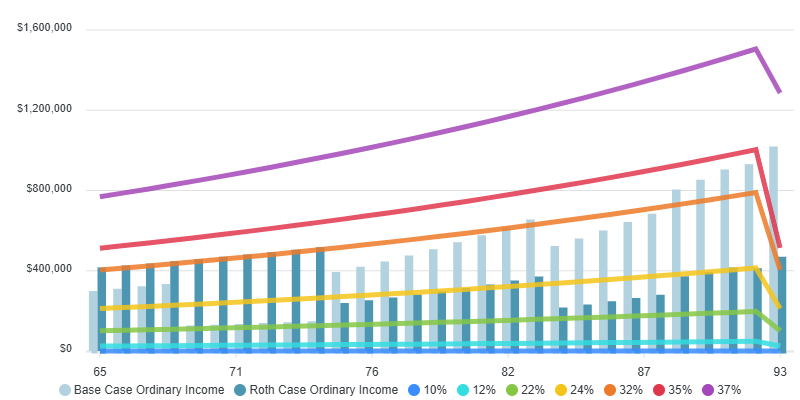
The illustration above compares two otherwise identical pre-retirees and their respective taxable income from part-time work, deferred compensation, Social Security, and other sources. One retiree (dark blue columns) completes annual Roth conversions between ages 65 and 74, while the other (light blue columns) allows assets to remain entirely within pre-tax retirement accounts.
Assuming average annual returns of 7% and a starting pre-tax retirement accounts balance of $3,000,000, the retiree implementing Roth conversions reduces their lifetime tax liability by approximately $975,641 (in today’s dollars) and finishes retirement with an ending portfolio value approximately $1,428,651 higher (in today’s dollars) in comparison to the retiree who completed no conversions. In contrast, the retiree who did not complete conversions sees their income push into higher and higher tax brackets.
The differential in taxes is achieved because the retiree who completed Roth conversions experiences significantly lower future RMDs. During the years when most retirees are experiencing significant increases in income due to RMDs (note the increasing values in the light blue columns when RMDs begin at age 75), the retiree who plans carefully experiences lower average taxable income, which provides greater flexibility for withdrawals, tax planning, Medicare planning, and legacy objectives.
The greatest value of Roth conversions is often not the tax savings alone; Roth conversions offer flexibility and peace of mind given reduced IRS-mandated retirement account distributions.
Understanding IRMAA and Why It Matters for You
An important consideration when evaluating Roth conversions is the potential impact on your Medicare Premiums. Medicare utilizes a surcharge known as the Income-Related Monthly Adjustment Amount (IRMAA) to determine whether higher-income retirees must pay additional premiums beyond the base amount for Medicare Part B (2026 - $202.90 monthly) and Part D (2026 - ~$36 monthly) coverage.
IRMAA is calculated using your Modified Adjusted Gross Income (MAGI) from the tax year two years prior. For example, your 2028 Medicare premiums are generally determined using the MAGI reported on your 2026 federal tax return. As MAGI rises above certain thresholds established by Medicare, retirees move into progressively higher IRMAA brackets, resulting in increased monthly Medicare premiums.
Because a Roth conversion increases taxable income in the year it is completed, a sufficiently large conversion may push you into a higher IRMAA bracket. For example, a retiree intentionally converting assets from a Traditional IRA to a Roth IRA may save substantial taxes over their lifetime while temporarily increasing their Medicare premiums two years in the future (as a result of the additional income reported during the Roth conversion year in question).
At first glance, IRMAA surcharges may cause some retirees to avoid Roth conversions altogether. However, failing to convert due to one or two years of higher IRMAA surcharges is often shortsighted. While a Roth conversion may increase Medicare premiums temporarily, the additional IRMAA cost is often small relative to the potential lifetime tax savings generated through reduced future Required Minimum Distributions (RMDs).
The objective is not to avoid IRMAA increases at all costs. Prudent Roth conversion planning seeks to evaluate whether the long-term benefits outweigh the temporary increase in Medicare Premiums and taxes. In many circumstances, retirees implement a series of smaller annual Roth conversions, intentionally filling lower federal tax brackets while managing exposure to higher IRMAA thresholds.
Working in tandem with a financial advisor and tax professional will help you identify a Roth conversion amount structured around your current tax picture, Medicare costs, future RMDs, and long-term retirement goals. AI can educate you about the benefits of Roth Conversions, but it is not sophisticated enough to understand your goals nor to marry the appropriate strategy like Roth conversions to those goals. Furthermore, AI does not understand the application of the tax code.
Roth Conversions as a Legacy Planning Tool
While Roth conversions are frequently discussed as a tax reduction strategy in retirement, conversions may also serve as a valuable estate planning tool.
The IRS generally requires non-spouse beneficiaries to distribute inherited retirement accounts within ten years (there are limited exceptions) after the death of the original account older. Consequently, non-charity heirs who inherit material pre-tax retirement assets often face substantial taxable income during peak earning years.
Example:
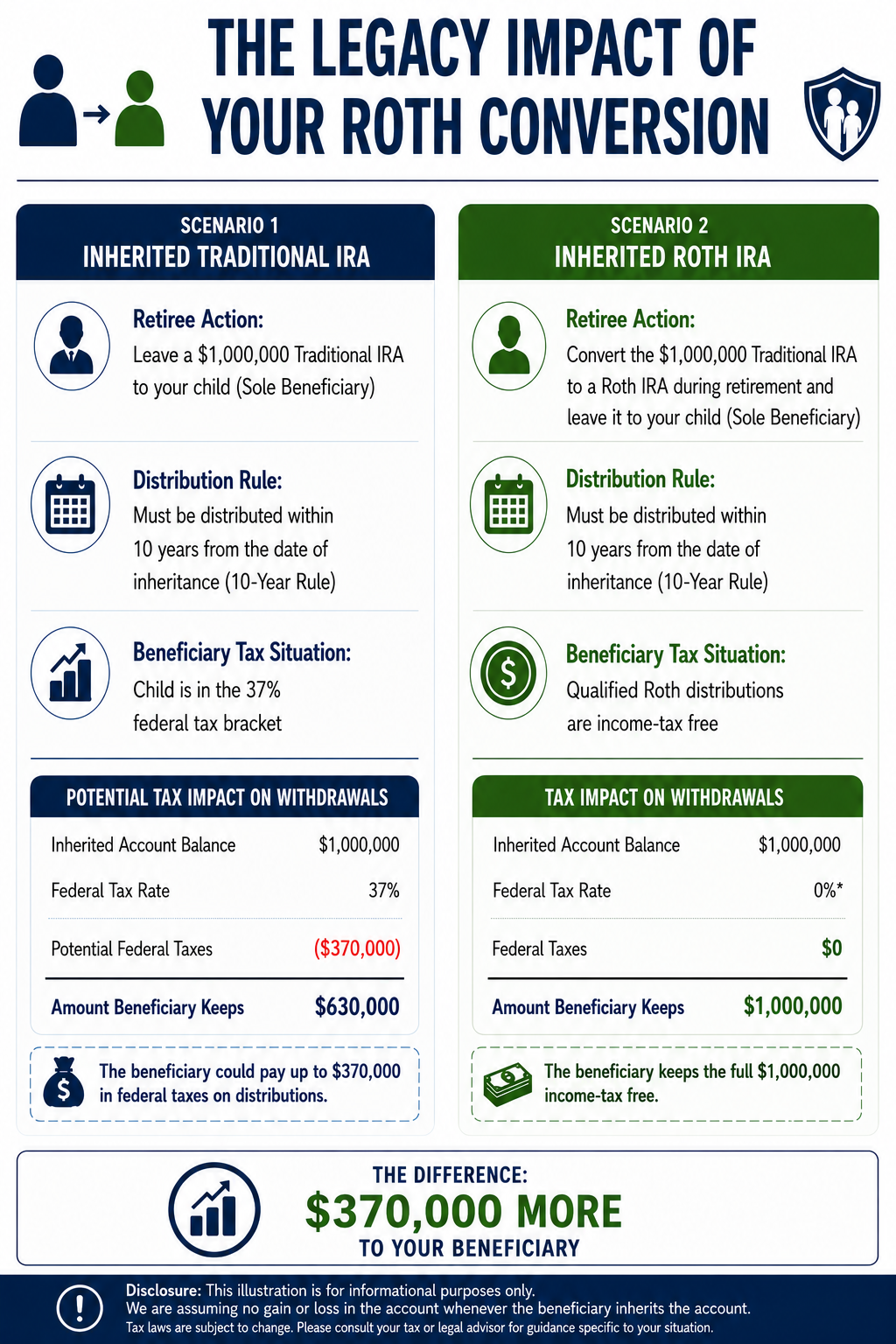
Assume a retiree leaves a $1,000,000 Traditional IRA to a child who is a successful executive currently in the 37% federal marginal income tax bracket. For most beneficiaries, the balance of the Inherited IRA is mandated for distribution within a ten-year window following an inheritance. As distributions occur, the beneficiary may pay as much as $370,000 in federal income taxes, depending upon future tax rates, sustained income, and additional sources of income.
Now consider an alternative scenario in which the retiree converted the account into a Roth IRA before passing away, perhaps within the 22% tax bracket. Although the beneficiary remains subject to inherited account distribution requirements, qualified distributions from the Inherited Roth IRA are generally tax-free. In essence, the beneficiary could receive $370,000 in extra wealth accumulated by the retiree rather than turning over 37% to “Uncle Sam.” Even if other inherited assets are reduced by $220,000 for tax paid by the retiree at 22%, the beneficiary receives $150,000 more after-tax due to the retiree’s prudent tax planning. Notably, the aforementioned scenario also does not account for the future appreciation of the Inherited Roth IRA funds, nor the fact the most beneficiaries are able to delay distributing the Roth account balance until the final year within the ten-year distribution window. Additionally, if the beneficiary is in a state with a high income tax when the original owner of the IRA was in a low-tax or no-tax state, the benefits of the conversion are even more material.
For families seeking to maximize the value of assets which ultimately reach children, grandchildren, siblings, or other human heirs, Roth conversions create an additional layer of tax efficiency. There are even opportunities to plan carefully around Roth conversions if your heirs are in differing tax brackets. If your heirs are charities, your approach to Roth conversions is more nuanced.
Concluding Remarks
Retirement planning involves far more than investment planning alone. For many successful retirees, managing tax planning ultimately becomes one of the most important determinants of long-term financial success.
Roth conversions represent one of the most powerful strategies available to reduce future Required Minimum Distributions (RMDs), improve tax diversification, create greater retirement income flexibility, and transfer more tax-efficient assets to future generations. While Roth conversions are not appropriate for everyone, converting to Roth is a strategy many will find beneficial.
Like all financial planning strategies, Roth conversions require thoughtful analysis. Current tax brackets, future income needs, Medicare premium considerations, estate planning objectives, available resources to pay Roth conversion taxes, and your personal values / goals all influence whether a conversion strategy is appropriate for your circumstances.
Your time in retirement is better devoted to family, travel, charitable interests, health, and the pursuits most meaningful to you, rather than navigating increasingly complex tax rules. A knowledgeable financial advisor working alongside your tax professional should evaluate whether Roth conversions support your broader financial goals and long-term vision for retirement. With thoughtful planning and a clearly defined strategy, Roth conversions may help transform future tax uncertainty into greater flexibility, confidence, and control over your retirement income.
Co-Authors:
Kaden Kozsuch
Justin Reede, CFP®, CKA®
Disclosure: The investment returns of investment securities are subject to various risks and are not guaranteed. Consult with an investment advisor representative for formal investment advice. For tax compliance advice, we recommend you consult with a CPA or Enrolled Agent. For legal advice, we recommend you consult with legal counsel. This blog post should not be considered investment or tax advice.